

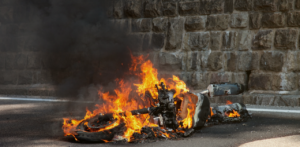
A motorcycle accident usually happens before the rider has time to make sense of what went wrong. A car starts turning left across traffic. A driver drifts into the next lane without checking a blind spot. Loose gravel appears in the middle of a curve. A door opens beside parked cars. In each situation, the rider may only have a split second to brake, swerve, or brace for impact.
That is what makes motorcycle crashes so dangerous. Motorcyclists have to manage the same traffic risks as everyone else, but with far less protection when another driver makes a mistake or when road conditions suddenly change. Even a crash at low speeds can leave an injured rider dealing with emergency care, missed work, motorcycle damage, and pressure from an insurance company that may try to shift blame. Understanding the common causes of motorcycle accidents can help explain why the crash happened and who may be legally responsible.
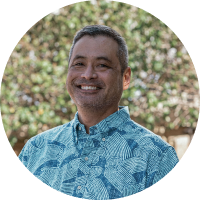
At Recovery Law Center, Attorney Glenn Honda brings 29 years of experience handling personal injury cases and helping injured clients pursue successful settlements. If you were hurt in a motorcycle accident, our motorcycle accident lawyer can help investigate the cause of the crash, deal with the insurance company, and determine whether another party may be responsible for your injuries.
Distracted Driving by Other Drivers
Distracted driving is one of the most dangerous causes of motorcycle collisions. A driver who looks away from the road for even a moment may not see a motorcycle rider slowing down, changing lane position, or approaching an intersection.
Driver distraction can include:
- Texting or using a phone
- Looking at GPS directions
- Talking to passengers
- Eating or drinking
- Adjusting music or climate controls
- Looking at something outside the vehicle instead of the road
Motorcycles are smaller than cars and large trucks, which means drivers already need to pay close attention to spot them. When a driver is distracted, the risk becomes even greater. A distracted car driver may drift into a motorcycle’s lane, fail to stop in time, or turn directly into the path of an oncoming motorcycle.
These crashes are especially dangerous because the motorcyclist usually has little time to react. By the time the rider realizes the driver is not paying attention, there may not be enough space to brake, swerve, or avoid the collision.
Drivers Failing to See Motorcyclists
Many motorcycle accidents happen because drivers claim they “never saw” the rider. That does not automatically excuse the driver. Every driver has a responsibility to check mirrors, scan intersections, look for smaller vehicles, and pay attention to the road.
Motorcycles can be difficult to see because they are narrower than passenger vehicles. They may also be hidden by other cars, road curves, shadows, traffic signs, or blind spots. But drivers still need to take reasonable care before turning, merging, or changing lanes.
A driver may fail to see a motorcyclist when:
- Turning left across oncoming traffic
- Entering a roadway from a driveway or parking lot
- Changing lanes without checking blind spots
- Merging onto a highway
- Pulling away from a curb
- Opening car doors into traffic
This type of negligence can cause severe motorcycle crashes because the rider may have no safe escape route. A driver’s failure to see a motorcycle often becomes a key issue in motorcycle accident claims.
Left-Turn Accidents
Left-turn crashes are among the most common causes of motorcycle accidents. These collisions often happen when a driver turns left in front of an oncoming motorcycle at an intersection.
The driver may think there is enough time to complete the turn. They may misjudge the motorcycle’s speed. They may be distracted. Or they may simply fail to yield.
For the motorcycle rider, this creates an extremely dangerous situation. The rider may be traveling straight with the right of way when the car suddenly crosses the lane. If the motorcycle is too close, the rider may not have enough space to stop.
Left-turn motorcycle collisions can happen when:
- A driver turns left at an intersection
- A driver turns into a driveway or parking lot
- A vehicle crosses oncoming traffic without yielding
- Oncoming traffic blocks the driver’s view
- A driver rushes through a yellow light
- The driver underestimates how quickly the motorcycle is approaching
These crashes often lead to serious injuries because the front of the motorcycle may strike the side of the passenger vehicle. In other cases, the rider may be thrown from the bike while trying to avoid the crash. For a full breakdown of what to do after this type of collision, see our guide on what to do after a truck or motorcycle accident.
Speeding and Excessive Speed
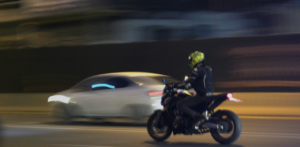 Speeding is a major risk factor in motorcycle accidents. This applies to both motorcycle riders and drivers of other motor vehicles. When anyone on the road travels above the speed limit or too fast for conditions, there is less time to recognize potential hazards and respond safely.
Excessive speed can cause a rider or driver to lose control, especially in curves, intersections, construction zones, or heavy traffic. Speeding also makes crashes more violent. The faster a vehicle is moving, the greater the impact force.
Speeding can contribute to motorcycle accidents by:
- Reducing reaction time
- Increasing stopping distance
- Making lane changes more dangerous
- Making it harder to avoid road hazards
- Increasing the risk of fatal injuries
- Making motorcycle collisions more severe
A high-speed motorcycle crash may also lead to disputes over fault. Insurance companies may try to blame the rider, even when another driver caused the dangerous situation. That is why evidence matters in these cases.
Unsafe Lane Changes and Blind Spots
Unsafe lane changes are another leading cause of motorcycle collisions. Motorcycles are smaller than cars, which makes them easier to miss in mirrors or blind spots. A driver who moves into another lane without carefully checking can sideswipe a motorcycle or force the rider off the road.
This often happens on highways, multi-lane streets, and congested roads where vehicles are moving close together. If a rider is beside a car, behind a large truck, or between other vehicles, the driver may not notice the motorcycle until the crash occurs.
Unsafe lane change accidents may involve:
- Drivers failing to signal
- Drivers failing to check blind spots
- Cars drifting into the rider’s lane
- Vehicles cutting off motorcycle riders
- Drivers merging without leaving enough space
- Other cars are blocking the rider’s escape path
Lane position can also affect crash risk. A motorcyclist rides in a position that improves visibility and safety, but that does not guarantee that other drivers will pay attention. Drivers must still check carefully before moving into another lane. For more on how common causes of motorcycle accidents in Honolulu play out locally, our dedicated resource breaks down the patterns seen across Oahu roads.
Lane Splitting and Unsafe Passing
Lane splitting can become dangerous when there is insufficient space between vehicles or when drivers do not expect a motorcycle to pass between lanes. Depending on where the crash happens, lane splitting may also raise complicated questions about fault.
The danger often comes from limited reaction time. A car may suddenly change lanes, a door may open, or traffic may shift without warning. If the motorcycle rider is close to other vehicles, there may be no room to avoid a collision.
Lane splitting and unsafe passing may contribute to motorcycle crashes when:
- Vehicles are too close together
- Drivers fail to check mirrors
- Riders pass at excessive speed
- A driver opens car doors into traffic
- Other cars shift lanes suddenly
- The rider has no safe space to maneuver
Not every lane-splitting accident is the rider’s fault. A driver may still be responsible if they make an unsafe lane change, fail to signal, open a door without looking, or create a dangerous situation.
Reckless Riding and Risky Rider Behavior
Many motorcycle accidents are caused by careless drivers, but rider behavior can also contribute. Reckless riding can increase crash risk and make injuries more severe.
Examples of risky rider behavior include:
- Riding too fast for traffic or weather conditions
- Weaving between vehicles
- Tailgating
- Ignoring traffic signals
- Taking curves too quickly
- Riding in unsafe lane positions
- Failing to adjust to road hazards
- Riding without proper training
Even experienced riders can make mistakes. A rider may misjudge a curve, fail to notice loose gravel, or be unable to react when another vehicle cuts them off. In many cases, the cause of a motorcycle crash is not one single action, but a combination of risk factors.
For example, a rider may be traveling slightly above the speed limit when a distracted driver makes an unsafe left turn. The insurance company may focus only on the rider’s speed, while ignoring the driver’s failure to yield. A careful investigation is often needed to understand what really caused the crash.
Alcohol-Impaired Driving or Riding
Alcohol impairment is a serious contributor to fatal crashes and motorcycle fatalities. Alcohol affects judgment, coordination, vision, and reaction time. This makes it dangerous for both motorcycle operators and passenger vehicle drivers.
An alcohol-impaired driver may fail to see a motorcycle, drift across lanes, run a red light, or turn without yielding. An impaired rider may lose control, misjudge distance, or react too slowly to a hazard.
Alcohol-related motorcycle accidents may involve:
- Delayed braking
- Poor balance
- Unsafe turns
- Drifting into oncoming traffic
- Failure to maintain lane position
- Excessive speed
- Reduced ability to avoid potential hazards
Because motorcycles require balance, coordination, and quick decision-making, impairment can be especially dangerous for riders. When alcohol is involved, the crash may lead to serious injuries, fatal injuries, and complicated legal claims.
Road Hazards and Environmental Factors
Road conditions that may be minor for cars can be extremely dangerous for motorcycles. A pothole, patch of loose gravel, or uneven pavement can cause a rider to lose control. Wet roads, poor lighting, debris, and construction zones can also create dangerous conditions.
Common road hazards include:
- Uneven pavement
- Loose gravel
- Potholes
- Oil slicks
- Standing water
- Poorly marked construction areas
- Debris in the road
- Missing or damaged signs
- Dangerous curves
- Fixed objects near the roadway
Environmental factors can also increase crash risk. Rain, fog, glare, darkness, and poor visibility can make it harder for both riders and drivers to see and react.
Some motorcycle crashes involving road hazards are single-vehicle crashes. That means no other car directly hits the rider. However, that does not always mean the rider is fully responsible. A government agency, construction company, property owner, or maintenance contractor may be responsible if unsafe road conditions caused or contributed to the crash.
Mechanical Problems and Motorcycle Defects
Mechanical problems can also cause motorcycle accidents. A motorcycle depends on properly working brakes, tires, lights, steering, and suspension. When one of these systems fails, the rider may have little chance to avoid a crash.
Mechanical issues may include:
- Brake failure
- Tire blowouts
- Defective lights
- Steering problems
- Chain or belt failure
- Faulty repairs
- Poor maintenance
- Defective motorcycle parts
The responsible party depends on the facts. If the motorcycle was poorly maintained, the owner or operator may be partly responsible. If a repair shop failed to fix the bike correctly, the shop may be found at fault. If a defective part caused the crash, the manufacturer or distributor may be involved.
These cases often require a detailed investigation because the motorcycle itself may contain important evidence.
Lack of Proper Training and Experience
Proper training matters because motorcycle riders face different risks than car drivers. Riders need to understand braking, balance, lane position, visibility, cornering, and how to respond to potential hazards.
New riders may be more likely to panic, overcorrect, brake too hard, or misjudge curves. But inexperience is not the only concern. Even experienced riders can be seriously injured when other drivers fail to pay attention.
Training can help riders learn how to:
- Maintain a safe lane position
- Avoid blind spots
- Brake safely
- Watch for left-turning vehicles
- Recognize road hazards
- Leave enough space
- Ride defensively around other vehicles
Still, proper training does not absolve other drivers of their responsibility. A careful, experienced rider can still be hit by a distracted driver, a speeding driver, or a driver who fails to yield at a left turn.
Why Motorcycle Accidents Are Often So Serious
Motorcycle accidents are different from many other traffic crashes because the rider has very little protection. A car driver may walk away from a collision with minor damage to the vehicle, while the motorcyclist involved may suffer broken bones, head trauma, spinal injuries, road rash, or fatal injuries.
Even at low speeds, a motorcycle crash can throw a rider onto the pavement or into fixed objects such as guardrails, signs, curbs, or other vehicles. At high speeds, the risk of fatal motorcycle crashes increases sharply because there is less reaction time and less room to avoid impact.
Motorcycle riders also face unique risks on the road. They can be harder for other drivers to see, especially near large trucks, in blind spots, between two lanes, or in heavy traffic where other cars block visibility. When drivers fail to notice a motorcycle or misjudge its speed, the result can be devastating.
For injured motorcyclists, the aftermath often includes medical bills, missed work, pain, long-term treatment, and disputes with insurance companies. Understanding the causes of motorcycle accidents is so important because the cause of the crash often determines who may be legally responsible. In cases involving severe harm, our catastrophic injuries page explains what those claims look like and what compensation may be available.
Call a Motorcycle Accident Lawyer at Recovery Law Center
If you were injured in a motorcycle accident, understanding the cause of the crash is one of the first steps toward protecting your claim. The accident may have been caused by distracted driving, a left-turn collision, speeding, unsafe lane changes, road hazards, or another dangerous condition.
Recovery Law Center can help you determine what happened and who may be responsible. With 29 years of experience, Attorney Glenn Honda helps injured clients pursue compensation after serious accidents and has handled successful personal injury case settlements.
Call us today to discuss your motorcycle accident claim and learn how the firm can help you move forward.